« Money is not the problem »: at SITHO 2026, Néré Capital calls for rethinking the financing of Sahelian tourism
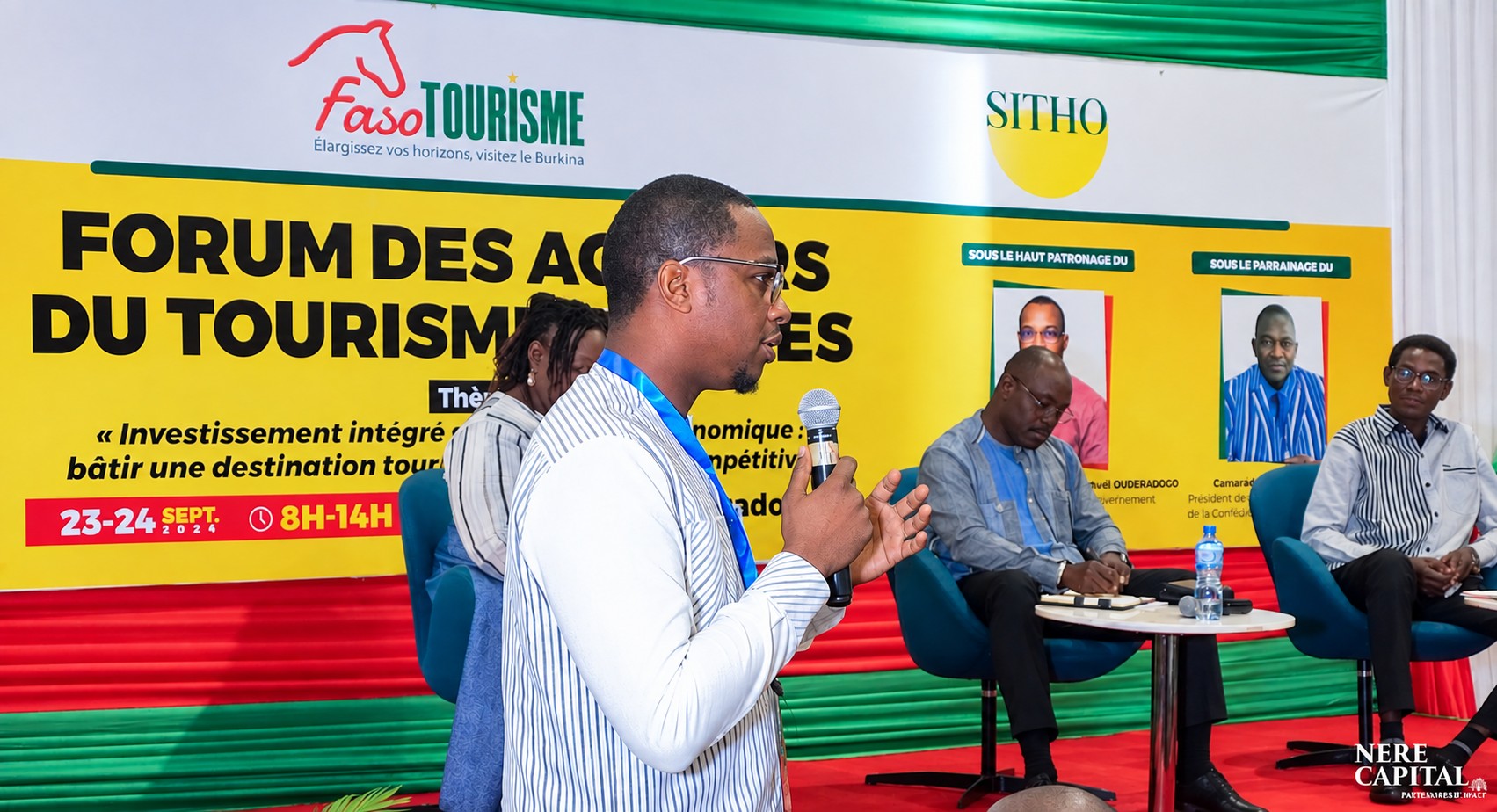
On 23 September 2026, during the Forum of Tourism Stakeholders of the AES (Alliance of Sahel States), organised as part of the 16th edition of the Ouagadougou International Tourism and Hospitality Fair (SITHO), Néré Capital advocated for financing better adapted to the realities of the sector. Its Investment Director, Brice Gaël Soubeiga, called for the establishment of mechanisms capable of sustainably supporting entrepreneurs, from the idea stage through to growth.
Addressing the professionals gathered in Ouagadougou around the theme « Integrated investment and economic sovereignty: building a competitive Sahelian destination », the Investment Director got straight to the point. According to him, the problem is not so much the lack of financial resources as the difficulty of matching the needs of project holders with the expectations of investors.
« Just as stakeholders need financing, financiers need to finance. They cannot find good projects, and you, you cannot find people to finance you », he told the audience.
Néré Capital, a growth partner for SMEs

From left to right: Bassolma Bazié, President of the National Commission of the AES; Pingdwendé Gilbert Ouédraogo, Minister of Culture, Arts and Tourism; and Pr Serge Balibié Auguste Bayala, President of the Confederated Bank of the AES.
Taking advantage of this platform, the investor recalled the specificity of Néré Capital within the Burkinabè financial ecosystem. The fund intervenes mainly through equity and quasi-equity, an approach that makes it possible to support SMEs without systematically requiring the classic guarantees, which are often out of reach for young companies. More than a mere financier, Néré Capital intends to be a partner committed to their development.
« We become shareholders, so we finance without guarantees and we support the company throughout its growth. Instead of relying on a guarantee to be sure of recovering our funds, we invest in growth, in the future », he explained.
A philosophy particularly suited to tourism, whose investment cycles are often long and require patient capital.
Bridging the « missing link »

Tourism and hospitality professionals gathered on the occasion of the Forum.
The main observation drawn by the representative of Néré Capital: intermediate solutions are missing between start-up grants (common in the sector) and conventional bank credit. In current pathways, many entrepreneurs move almost directly from a small grant to a bank loan. Between the two remains a « missing link » where many promising projects remain stuck, for lack of instruments adapted to their stage of development.
It would, however, be illusory, he warned, to look for a single mechanism for the whole sector. A start-up idea, an SME seeking to scale up and a large hotel project are not financed in the same way.
Hence his recommendation: build a complete chain of instruments, from zero-interest repayable advances to kick-start activities, through seed funds, private equity (venture capital or growth capital) and equity stakes, up to subsidised loans. A subsidised loan, in which a public actor covers part of the interest, reduces the cost of a loan or extends its duration. In short, the aim is to give each project the right fuel, at the right time, rather than imposing a solution that is too expensive, too short or too premature.
Financing, but also equipping
The intervention also recalled a sometimes-forgotten truth: excelling in one’s craft is not always enough to build a company. « A stakeholder in the field may be very brilliant on the tourism aspects. But that does not make them an entrepreneur. An entrepreneur is many things. They need to be equipped », stressed Brice Gaël Soubeiga. Financing must therefore be accompanied by support that helps the company structure itself. And the effort must be shared: financiers, too, have every interest in better understanding the realities and values of the tourism sector in order to support it effectively.
To conclude his intervention, he brought the debate back to a central idea: more than the availability of capital, it is its adequacy to the real needs of companies that conditions the development of the sector. The future of Sahelian tourism will depend, in his view, on better-supported entrepreneurs, better-structured projects and better-adapted financing. Only on this condition can the tourism potential of the AES area be transformed into lasting economic opportunities.
Do you have a high-potential project? Néré Capital is at your side to support your growth.